
About
DocLime is an AI document assistant for asking questions about PDFs and other uploaded documents. Users can upload a document, chat with its content, inspect the PDF in a viewer, take notes, and receive answers backed by document references. It supports scanned PDFs through OCR, multiple PDF conversations, vision questions about screenshots, and access to frontier models from OpenAI, Anthropic, and others.
✨ Key Features
- Chat with PDFs — Upload a PDF and ask questions about its contents.
- Ground answers in documents — Receive responses backed by references from the uploaded material.
- View and manage PDFs — Search, zoom, navigate pages, and organize documents in a library.
- Work with multiple PDFs — Ask questions across several documents for cross-reference work.
- Read scanned PDFs — Use OCR to convert scanned pages into machine-readable text.
- Take notes while reading — Capture document insights alongside the PDF viewer.
- Use vision questions — Take a screenshot of part of a document and ask about its visual content.
- Use multiple AI models — Access models from OpenAI, Anthropic, and other providers.
- Chat without documents — Use the AI interface directly for general questions as well as document work.
- Protect document access — Documents are stored privately by default on the service infrastructure.
💳 Pricing
DocLime’s public pages confirm a free account path and a Pro upgrade, but the reviewed official pages do not expose a stable text price or a complete quota table. Verify the current Pro price, document limits, model limits, and any team/enterprise options before purchase. Monthly subscriptions can be canceled from billing.
⚖️ Alternatives Compared
| Product | Best for | Public pricing | Key difference |
|---|---|---|---|
| DocLime | PDF chat with references and notes | Free account; Pro pricing requires verification | Combines PDF chat, viewer, OCR, notes, screenshots, and multiple-document work |
| ChatDOC | Conversational document analysis | Free and paid options | Focuses on asking questions and summarizing uploaded documents |
| Humata | AI questions over files | Free and paid options | Provides a file-based AI reading and question-answering workflow |
| Chatbase | Knowledge-grounded chatbots | Free and paid options | Focuses on deploying document-grounded assistants for end users |
🎯 Use Cases
- Students asking questions about textbooks and papers.
- Researchers cross-referencing several PDFs.
- Lawyers checking obligations in legal documents.
- Analysts extracting facts from financial reports.
- Professionals reviewing technical manuals.
- Readers working with scanned documents through OCR.
- Teams keeping notes alongside source documents.
- Users asking visual questions about charts or scanned pages.
- Developers evaluating document-chat workflows with different models.
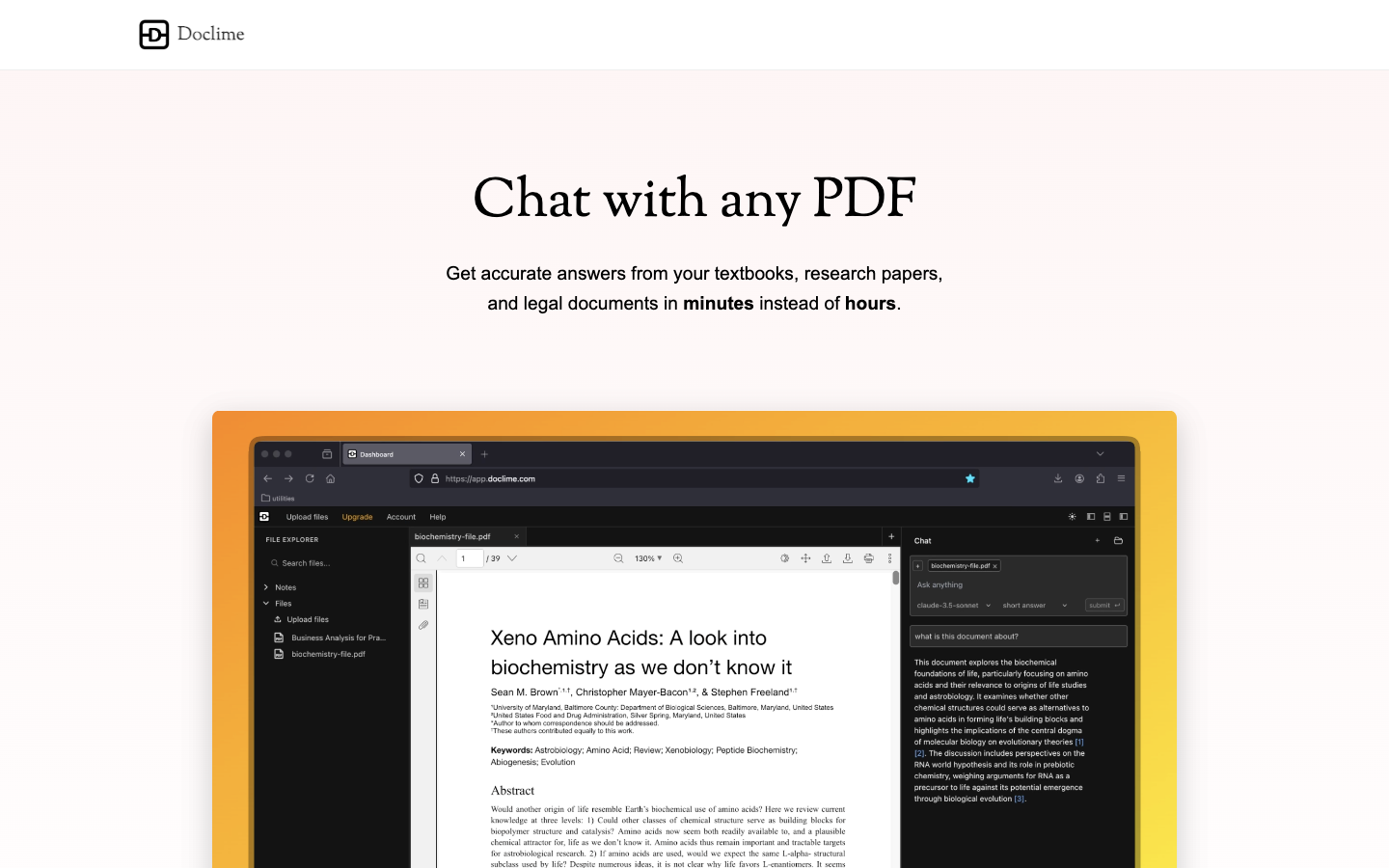
DocLime Website Overview
DocLime has an Ahrefs Domain Rating of 24 and falls within Cloudflare Radar's global top 200,000 popularity bucket. This bucket is unordered, and neither signal represents actual visits.
- Domain rating
- 24
- Popularity position
- Top 200,000
- Primary category
- Unavailable
- Ranked locations
- 0
Ahrefs
Cloudflare Radar
Cloudflare Radar
Cloudflare Radar
Website categories
No category data is available yet.
Top locations by rank
No location ranking is available yet.
Data coverage
Free popularity and domain-authority signals only; no estimated visits or engagement metrics are shown.
Sources: Domain Rating by Ahrefs · Cloudflare Radar · Oct 18, 2026. Cloudflare Radar data is licensed under CC BY-NC 4.0.
Similar tools
SciSpace
FreemiumAI workspace for discovering, reading and writing scientific literature
Connected Papers
FreemiumVisual graphs for discovering and exploring related academic papers
ResearchRabbit
FreemiumDiscover related papers through visual citation maps and organize literature in shared research collections.
Elicit
FreemiumAI research assistant for finding, understanding, and synthesizing academic papers
Rayyan
FreemiumCollaborative literature-review platform for screening studies and organizing evidence